The short answer
Consider a new furnace when yours is aging, needs frequent repairs, heats unevenly, or has a safety problem such as a cracked heat exchanger. If the issue is a single failed part, a repair may be enough. PrimeBreeze inspects your system and home, then lays out repair, new gas furnace, and heat pump options with a written quote.
In San Jose, a furnace doesn't work as hard as one in a colder state, but it still has to handle chilly, damp winter nights and mornings. When yours is aging, unreliable, or simply the wrong size for your home, a replacement can make the house more comfortable and easier to keep at a steady temperature. PrimeBreeze HVAC Repair Service installs furnaces for homeowners in San Jose and nearby cities. This page covers how to tell when replacement makes sense, what we look at before recommending anything, your options, what drives the cost, and what to expect on installation day.
Signs You May Need a New Furnace
Most furnaces give warning before they quit. South Bay winters are mild, so a furnace may sit idle for months, and problems can go unnoticed until the first cold snap. Watch for these signs:
One situation is always urgent. If you smell gas or your carbon monoxide alarm sounds, leave the house and contact your gas utility or emergency services from outside before anyone works on the furnace.
- Repairs are becoming frequent, or the same part keeps failing.
- Some rooms stay cold while others overheat, even with the vents open.
- The burner flame looks yellow or flickers instead of burning a steady blue.
- New rattling, banging, squealing, or booming sounds when the furnace starts.
- Gas bills are climbing even though you haven't changed how you use the heat.
- More dust, dry air, or musty smells when the system runs.
- The furnace cycles on and off often, or it runs without reaching the set temperature.
What We Check Before Recommending Anything
A good installation starts with a look at the whole system, not just the furnace cabinet. Before we recommend a replacement, a technician checks:
Sizing matters more than most people expect. An oversized furnace short-cycles and causes temperature swings. An undersized one runs constantly on cold nights. A load calculation based on your actual house is more reliable than copying the size of the old unit.
- Age, condition, and safety of the current furnace, including the heat exchanger, burners, and controls.
- Venting and flue, to confirm combustion gases exit safely and the vent suits the furnace type.
- Ductwork for leaks, crushed runs, poor insulation, and undersized returns. These problems are common in older homes and attic installations.
- Gas supply line, shutoff valve, and electrical service at the unit.
- Home size, insulation, windows, and layout, so the new equipment is sized to the house.
- Thermostat compatibility and air filtration.
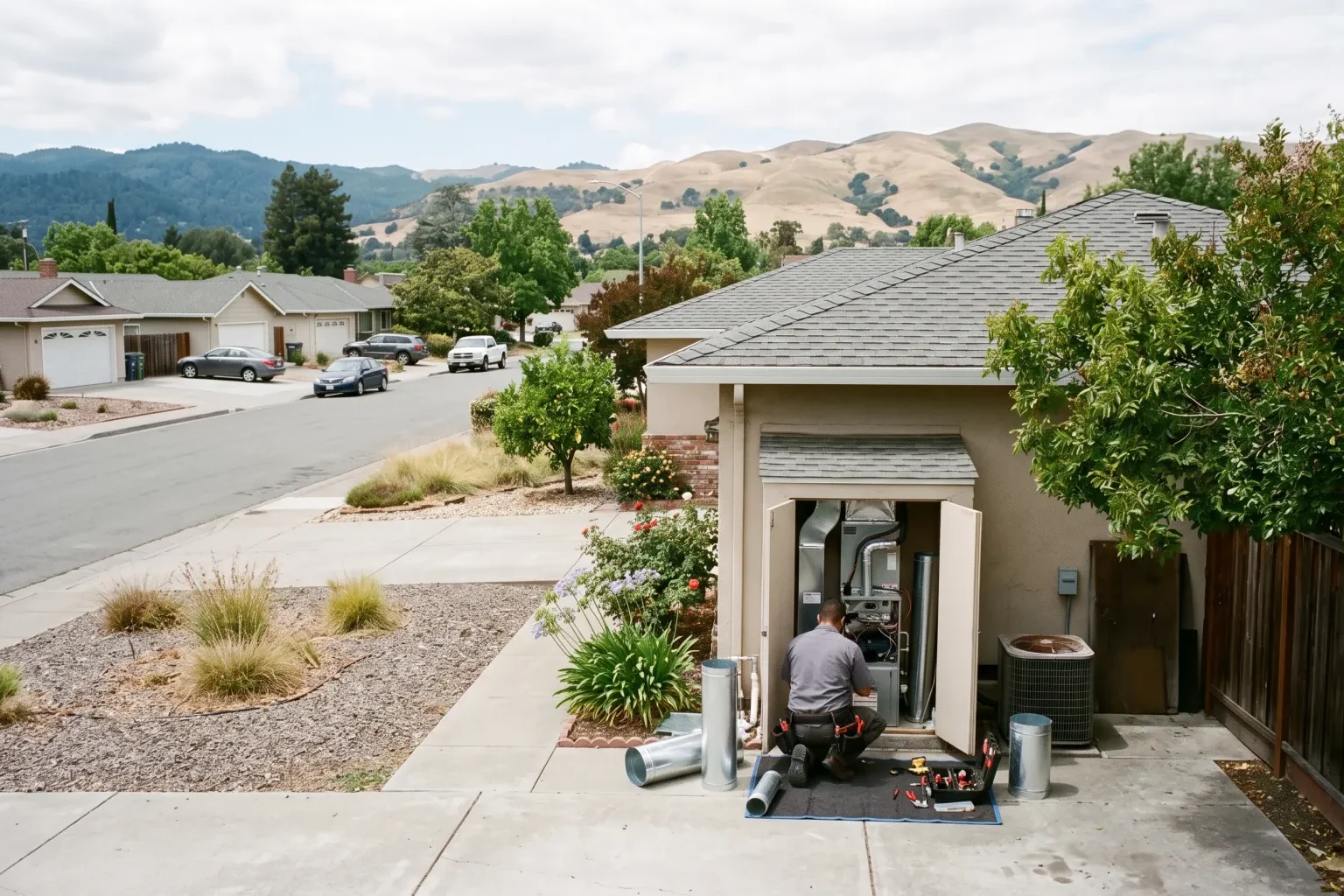
- Where the furnace sits (attic, garage, closet, or crawlspace) and whether there's enough room to work on it safely.
Repair, Replace, or Switch to a Heat Pump
Not every problem calls for a new furnace. If your furnace is relatively young and the problem is a single part, such as an igniter, flame sensor, blower motor, or control board, repair is often the sensible choice. We'll tell you when that's the case.
Replacement makes more sense when the unit is near the end of its service life, the heat exchanger is cracked, repairs keep stacking up, or parts are hard to find. At that point you generally have three paths:
Local air quality rules are worth knowing about. Bay Area Air District rules don't require you to replace a furnace that still works. They apply only when equipment fails or is replaced. Under Rule 9-4, natural gas furnaces manufactured from 2029 must meet a zero-NOx emission standard. In practice, that points homeowners toward heat pumps when they replace a furnace after that date. If you're replacing now, think about how long you plan to stay in the home and whether a heat pump fits your plans.
The Santa Clara Valley has mild, damp winters and dry summers, and inland and southern parts of the valley get noticeably hotter in summer. For many homeowners, getting air conditioning in the same project is a big part of a heat pump's appeal. We'll explain the trade-offs plainly so you can choose.
- Replace it with a new gas furnace matched to your home and ductwork.
- Replace it with a heat pump, which heats and cools with one electric system.
- Install a dual-fuel setup that pairs a heat pump with a gas furnace for backup heat.
What Affects the Cost of Furnace Installation
We give a written quote after the in-home assessment. The final cost depends on several factors:
Incentives can offset part of the cost, especially for heat pumps. You can check BayREN and your local clean energy provider for current heat pump and electrification incentives. Amounts and availability change by funding cycle, so we confirm the current offer before including it in a quote. The federal Energy Efficient Home Improvement Credit (25C) covered only qualifying heat pumps placed in service before December 31, 2025. It isn't available for new installations.
- Equipment type: a single-stage, two-stage, or variable-speed furnace, or a heat pump.
- The efficiency level of the unit.
- The correct size for your home.
- Installation location and access, such as a tight attic or closet.
- Whether the venting needs to be changed or updated.
- Ductwork repair, sealing, or replacement.
- Gas line or electrical upgrades. Heat pumps sometimes need panel or circuit work.
- Permits and inspections required by your city.
- Thermostat, filtration, or other add-ons.
How a Furnace Installation Visit Works
Here's what to expect from the first visit to the finished job:
Most standard furnace swaps take about a day. Heat pump conversions and jobs that involve duct or electrical work can take longer. We'll give you a realistic timeline up front.
- Assessment: A technician inspects your current system and home and asks how you use your heat and what bothers you about it.
- Options and quote: We explain your choices, including repair if it makes sense, and give you a written quote.
- Scheduling and permits: We set the installation date and pull any permits your city requires.
- Installation day: We protect floors and work areas, remove the old unit, set the new equipment, and connect the gas, venting, electrical, ductwork, and thermostat.
- Testing: We start the system, check for gas leaks, verify safe venting and proper airflow, and confirm it heats correctly.
- Walkthrough: We show you how to use the thermostat and change the filter, explain routine maintenance, and haul away the old equipment.